

2026 and The Rise of the Guardians Part 1: How Wisdom and Tribal Knowledge Make a Comeback
2025's expensive lesson: AI without wisdom is a money pit. Why Guardians will be the hottest hire of 2026.

We all had front row seats last year to the biggest technological shift since the internet went mainstream. Some of us even had backstage passes. Although AI didn’t arrive overnight, it felt as if it arrived overnight. It’s actually been growing like a quiet wild fire in research labs since 1950 when Alan Turing asked, “Can machines think?” However, despite decades of progress ramping up to this moment, it still took the world by surprise and quickly changed the landscape of how companies would hire and retain talent. From this brave new world, two opposing approaches to AI talent formed.
Company A: It’s 2025 and your company just fired almost everyone with institutional memory and went all-in on AI tools. The new hires are AI-native, efficient, and fast, but when something breaks that the AI didn’t predict, no one knows what to do. The system worked until it didn’t. And when it didn’t, there was no one left who remembered how or why it worked in the first place.
Company B: Meanwhile, also in 2025, your company hunkered down with business as usual, avoiding AI entirely. You kept the tribal knowledge and the people who understand your organization at a cellular level. They can tell you exactly why the 2019 initiative failed and what not to do this time. What they can’t tell you is how to compete with companies moving three times faster.
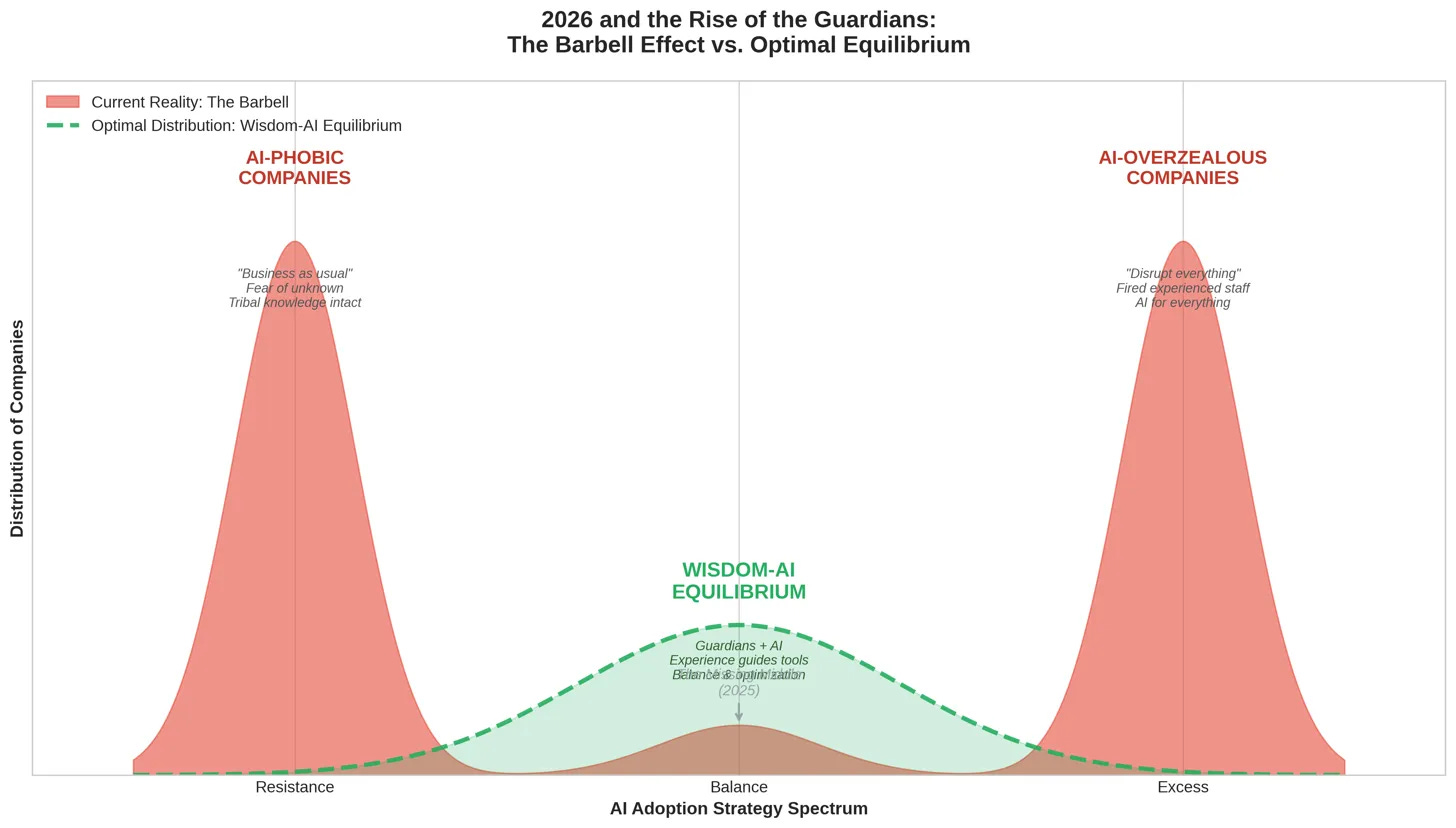
This chart below depicts my observation during 2025: a barbell (or bimodal) economy where most companies clustered at the extremes, while the optimal middle, where experience guides AI, stayed flat.
How We Got Here
As I watched this barbell effect take shape in real time over the last three years, it truly didn’t form the frenzied extremes until 2025. There was a scramble of companies racing to adopt tools without a plan. They weren’t asking the basic questions, “What’s the problem we are trying to solve?” “Do we have clean data? Governance? Security?” Instead, there was an ambiguous shoulder shrug. Speed was of the utmost importance and teams were hurtling towards destinations unknown in the attempt to get onboard the lightning-fast AI bullet train. AI was being built on shifting sands within organizations and by the fourth quarter of 2025, they were seeing little to no ROI (return on investment)1 described by McKinsey as the, “GenAI Paradox.”23
Today we are watching the live correction play out.
The AI Delirium of 2025
Here’s where most people went off track. And I say this having experienced it from the inside with that backstage pass I mentioned.
Some companies panicked. AI became the answer to every problem. Fire the expensive, experienced people and hire AI-native generalists, deploy the tools and watch productivity soar.
Some companies froze. Paralysis by analysis. Too confusing. Too much to learn. Too risky. Fear of the unknown. Let’s just…not.
And some companies saw chaos as opportunity. Move fast, reorganize (again), let people figure it out. Sink or swim. Disruption for the sake of disruption.
What they had in common: Skipping the part where they understood the problem they were solving. They didn’t build a foundation of clean data, governance, functioning systems or have an understanding of where and when AI would provide the biggest ROI.
Both sides of the barbell struggled to tell the story of how AI was truly making an impact for their company. One end had no context and the other end lacked the technological understanding needed to grow.
What Happens if You Don’t Have Guardians
When tech companies fired everyone with institutional memory, they lost judgement, not just headcount. They lost the people who knew why that 2019 initiative failed, which customers needed careful handling, and what actually works when the documented process breaks down.
This wasn’t the kind of knowledge you could extract and put in your company’s knowledge base. It was pattern recognition that companies had built over years. “This reminds me of the time that we tried it with Customer X during our European launch and it backfired because…” That’s the kind of wisdom that only comes from seeing multiple cycles over time, including the highs, the lows, what worked, what didn’t, and most importantly, WHY.
Companies fired tribal knowledge and hired talented AI practitioners who understood when to use ChatGPT vs NotebookLM. They purchased AI tools without clean data, without governance and without systems in place. Then everyone used the same locked-down, non-upgraded, singular AI tools to generate the same results. It became a homogenization problem.
I remember sitting in a meeting where everyone, myself included, had used the company’s AI tool to help with our strategy documents. We’d all used the same key phrases. I could just hear Homer Simpson and a “d’oh!” echo from everyone in the room.
For fun, after I wrote this article, I asked ChapGPT and Claude to generate the most stereotypical AI-written corporate announcement to use as an example. Here’s a compilation of what they gave me:
In today’s ever-evolving digital landscape, I’m excited to share how our teams are embarking on a transformative journey to leverage cutting-edge, groundbreaking solutions at the intersection of innovation, impact, and scale. By harnessing the power of a comprehensive, holistic approach, we’re unlocking unprecedented value, empowering stakeholders, and fostering a culture of continuous improvement. It’s crucial to recognize that this pivotal paradigm shift enables us to seamlessly drive insightful, data-driven decisions and elevate outcomes—truly a testament to what’s possible when we lean in, stay curious, and deliver meaningful impact together.
Grateful for the incredible team making this happen. Onward and upward. 🚀
Have you seen this post on LinkedIn or floating around the office? Did you, too, have the same “groundbreaking solution at the intersection of innovation, impact and scale?” Maybe you wrote something that sounded suspiciously close to it? (I did. No judgment.)
That’s the homogenization problem. When everyone’s using the same AI tool, with roughly the same prompts, everyone’s output starts looking the same. And when everything sounds the same, nothing stands out. In 2025, there was a “magic” aura around AI where leaders issued mandates to deploy AI tools and reduce inefficiencies. What everyone was learning was that AI without wisdom isn’t magic, or even a short-cut to ROI. It can be a money pit filled with lost time, unused licenses and subscription fees that no one remembers signing up for.
The new AI-native hires were fast and comfortable with the tools. But when something broke in a way the AI didn’t predict, they didn’t instinctively know what to do. The people who had worked in the office for multiple cycles had moved on and time and money had to be spent to reinvent all of the processes without context. For junior professionals, it can feel like AI is the only thing that matters.
Learning something entirely new mid-career after years of success is genuinely hard. I get it. You’re juggling work, family, maybe health issues, or you’re a care-taker for a loved one. No one makes it to mid-career without a story to tell about challenges overcome and sacrifices made. Time looks different when it is split in many directions and AI can feel like a threat to everything you’ve worked to build.
The barbell will start to rebalance in 2026. Not because everyone suddenly agrees, but because the teams that combine junior professionals, experienced Guardians, and AI tools will outperform the extremes by such a margin that it becomes impossible to ignore.
And despite all the predictions of AI eliminating jobs, I believe it will go the other way. They may not be the SAME jobs, but AI has already spawned new industries, and with that comes new jobs, new talent, new training. That’s what happens with every technological shift; the jobs evolve, they don’t disappear.
Junior professionals bring a fresh perspective and willingness to experiment and learn. Experienced professionals bring historical context, judgement and pattern recognition. AI tools amplify both groups when properly curated. Together, they tell THE story.
That’s not some utopian dream. I’ve seen it work. And the teams that figure this out? They become a force multiplier.
But in 2025, most companies weren’t building that. They were doing math that didn’t add up.
The Compounding, and Not-So Invisible, Damage
Here’s the calculation they missed during mass layoffs and mass AI tool purchases.
Harvard Business Review reports that 20% of new hires leave an organization within the first 45 days, cited by Julia Phelan in HBR4. According to the Society for Human Resource Management (SHRM), “estimates suggest each departure costs roughly six to nine months of salary, and Gallup’s analyses put the total cost of replacing an individual employee at 50% to 200% of annual pay, once you include recruiting, onboarding, and lost productivity.”5 When turnover runs high, teams operate in perpetual ramp mode always training someone new and never reaching full capacity.
What you can’t put in a spreadsheet:
The pattern recognition that comes from seeing three economic cycles
Knowing which customers are high maintenance vs genuinely challenging
Understanding why “we tried that in 2019 and here’s what went wrong”
Spotting when something’s about to break before the dashboard lights up red
That’s the knowledge that walked out the door when companies optimized for cost over wisdom.
Markets rewarded the disruption narrative. Announce layoffs, show margin improvements, watch the stock price climb. What markets couldn’t measure, and companies weren’t tracking, was the long-term erosion of judgement and organizational memory.
By late 2025, the bill was already coming due. And quietly, companies started looking for a different answer.
The Guardians
So that’s how we got here. While tech companies were setting their institutional memory on fire, traditional companies were doing something equally risky: preserving everything and learning nothing. They had wisdom without leverage. They preserved the past but couldn’t access the future. But here’s what makes a Guardian different from just being experienced:
Being a Guardian is not about age. It’s about the wisdom that comes from seeing multiple cycles, a growth mindset and the willingness to share what you’ve learned. You’ve seen the seasons of the business. The highs, the lows, what worked and what didn’t.
Looking through my eternal optimist glasses, here’s what I also started seeing in late 2025. Quiet signals. Message boards and social media talking about these challenges in side conversations. Job descriptions adding “experience required” back in.
What’s just starting to percolate now will define 2026 hiring: the Rise of the Guardian.
Not just experienced people. Not just AI-fluent people. But professionals who have both the judgement that comes from seeing cycles AND the willingness to learn new tools. People who can curate AI, mentor others and mitigate risks before they become issues.
But what exactly makes someone Guardian-level? What do companies need to look for? And if you’re experienced but worried you’re behind, how do you catch up?
Stay tuned for Part 2 next week. The framework and the playbook that turns this observation into a force multiplier for your organization.
https://www.gartner.com/en/newsroom/press-releases/2025-06-25-gartner-predicts-over-40-percent-of-agentic-ai-projects-will-be-canceled-by-end-of-2027#:~:text=Gartner%20estimates%20only%20about%20130,workflows%20and%20requiring%20costly%20modifications.
https://www.mckinsey.com/capabilities/quantumblack/our-insights/the-state-of-ai
https://www.pcbb.com/bid/2025-09-22-cracking-the-genai-paradox#:~:text=The%20disconnect%20between%20sky%2Dhigh,to%2Demerge%20gains%20in%20productivity.
https://www.forbes.com/sites/alainhunkins/2025/03/19/onboarding-that-sticks-how-to-help-new-employees-stay-and-thrive/
https://www.payactiv.com/blog/cost-of-replacing-an-employee/