
Pre-Flight Checklist: The AI Illusion (Post #13 of 20)
"Do you want to know what it is?"

“Remember. All I’m offering is the truth. Nothing more.”
Is AI adoption more hype than reality today?
AI’s potential is extraordinary, but reality is still catching up to the narrative. We’ll get there.
I love “The Matrix” for it’s moment of truth. Take the blue pill and stay comfortable in the illusion, or take the red pill and see things as they truly are.
Every AI journey begins with a choice of comfort or clarity. For me, this is where the real work of AI adoption begins.
What if everything we believe about AI adoption is just another illusion?
In the movie, Neo lives inside a system that feels real, but isn’t. Every detail around him looks normal, until Morpheus offers him a choice.
“You take the blue pill, the story ends. You wake up in your bed and believe whatever you want to believe. You take the red pill, you stay in Wonderland, and I show you how deep the rabbit hole goes.” ~Morpheus’s challenge to Neo
The illusion is that AI belongs to the few. The truth is that its future depends on everyone else.
Today, AI adoption is often more hyped than widespread in practice, with global data indicating that tech-related roles constitute only about 3-5% of total employment across the 38 countries that make up the Organization for Economic Co-Operation and Development (OECD), according to OECD1 and U.S. Bureau of Labor Statistics (BLS) .2
This means that approximately 95-97% of the global workforce, spanning sectors like transportation, retail, healthcare, education, agriculture, entertainment, and small businesses, are engaged in non-tech occupations, according to ILO World Employment and Social Outlook reports (2023-2025 editions),3 highlighting a vast opportunity for AI to enhance everyday efficiency and human progress.
By focusing on accessible, affordable tools tailored for these sectors, such as AI-driven scheduling in hospitals, time-keeping for attorneys/accountants, or inventory management in retail, we can democratize innovation and drive meaningful adoption.
Ultimately, we appreciate and applaud the visionaries and the brilliant minds behind AI (like those leading research institutions and companies). But its future success is grounded in humanity’s collective application to ensure that this technology evolves as a tool that for the global good, not just elite advancement.
For example of ideal candidates to rapidly adopt AI, see below charts from May 2024 showing major occupational groups as a percentage of total employment, according to the U.S. Bureau of Labor Statistics. 4
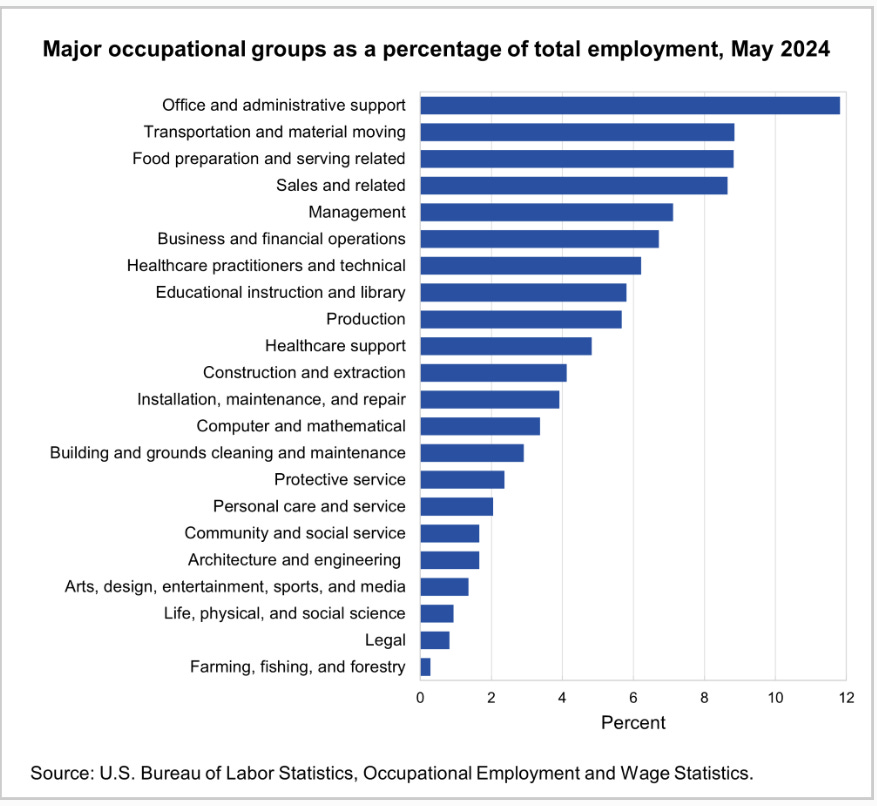
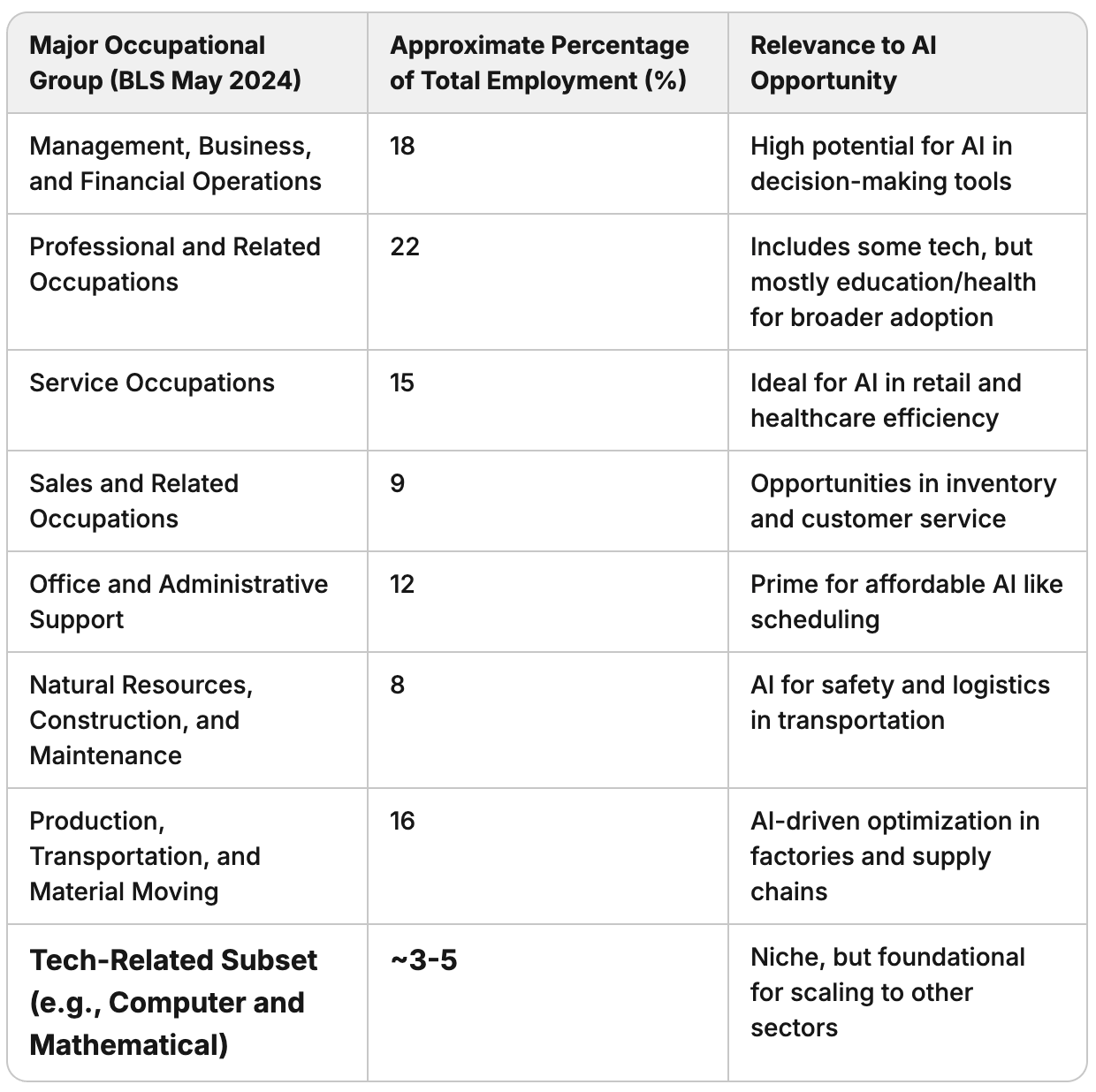
Once you take the red pill, once you better understand where and how AI is actually being used, you see the truth: The future of AI isn’t being built in secret labs; it’s being shaped in classrooms, clinics, studios and small businesses.
AI isn’t just a technology story. It’s a humanity story.
3 Steps to See Through the AI Illusion
If you choose the red pill…
Follow the Hype Trail. There’s a pretty loud AI echo chamber in the media today. List every AI headline, vendor claim, or “miracle” success story your team has discussed in the past month.
Where is it actually adopted, not just advertised?
Would it work in your organization tomorrow?
What is the implementation timeline?
What are the cost and resources required?
Trace the Real Users. Identify three places in your own organization, or your customer’s, where AI is already quietly working well. That’s where the truth lives. It’s in the time-tracking software, patient scheduling system, or the warehouse forecast, for example. Not in the press release.
Why is it working well?
What value is it providing?
Re-Center on Purpose. Ask one deceptively simple question, “Does this use of this AI increase or decrease efficiency in my organization?”
Test Flight: The Reality Audit
Give your team 48 hours to run a Reality Audit.
The task: For one AI tool you use or plan to buy, document:
What problem does it actually solve? (see Post #1)
What data does it truly need? (see Post #5)
What human process does it change, and how?
Then ask, “are we seeing the system for what it is, or just what we hope it will be?”
My prediction is the companies that will see the greatest success with AI adoption are the ones whose technology goes viral due to accessibility and customer obsession. It has to be easy, affordable and effective to get real traction.
Mission Debrief
How did it go? What did you discover?
Did the story you tell about AI in your organization match the reality on the ground? If not, good. That’s the work.
By breaking these illusions, we pave the way for AI to truly serve humanity’s 95-97% by driving adoption through easy, affordability and effectiveness.
This is very fresh thought on AI adoption vs the - hurry else we are screwed thoughts that is going around