

On writing. And what it's like to publish an eBook from your Substack posts
The AI tools, wrong turns and the angels that put me on the right path

With many mistakes and misfires along the way, I completed something that helped me create a foundation for my next chapter in life. Looking back on the last several months, there was no doubt what that next chapter should include. With zero hesitation, I wasn’t just running full speed towards my goal with reckless optimism, but also felt the pull, as if I was just along for the ride. The image in my mind is from the ride at Walt Disney World, “Tomorrowland,” where you ride along glimpsing into what the future will hold.
There were many lessons learned, myths that I had to reconcile, and a laundry list of what I will do different next time. But, it is done. I want to celebrate by sharing with everyone the impact of AI tools along the way, what worked and what didn’t.There were many lessons learned, myths that I had to reconcile, and a laundry list of what I will do different next time. But, it is done. I want to celebrate by sharing with everyone the impact of AI tools along the way, what worked and what didn’t.
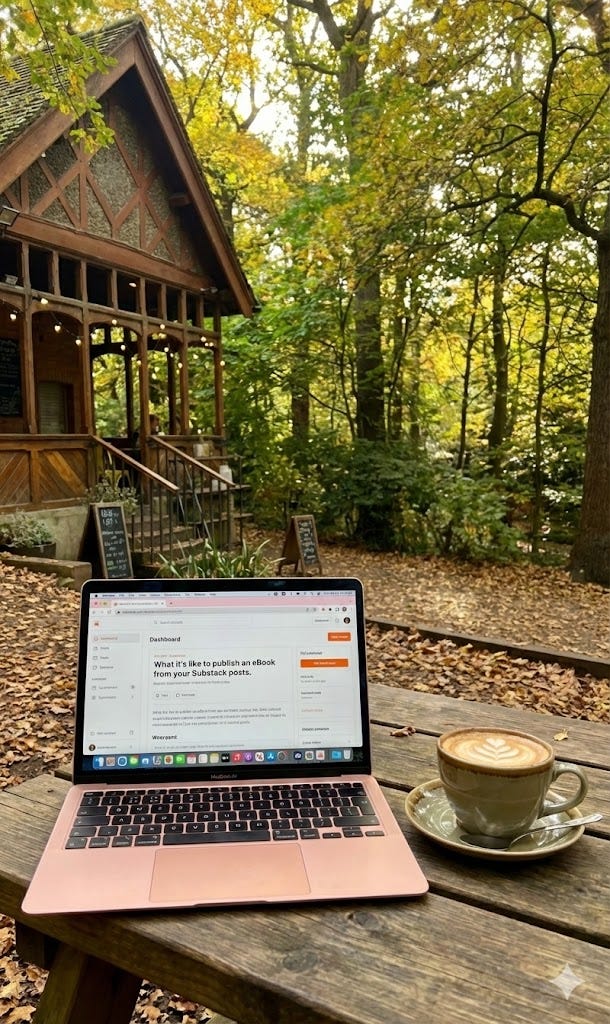
Lovely little spot to have a cappuccino in London.
How it Began
It was my first legitimate break in years from ridiculously long hours and the stress of a high-paced Big Tech corporate strategy and operations role. I look back on it as unrequited love. I really loved the job and my team, but the job did not love me. Lost moments with family. Lost moments with sense of self. Lost confidence. Loss of trust. Lost identity. Lost moments with simple pleasures. I’m pretty sure somewhere along the way, I’d also lost the ability to breathe.
One of the greatest gifts in life is time, and with this respite, time expanded, and simultaneously slowed down enough for me to breathe, find my voice, my purpose and see everything around me with a new push of color. I made a promise to myself to never let go of that again, despite temptations and offers to return to that lifestyle.
Without having to be concerned with how my thoughts and opinions were tied to my job, the floodgates opened. I’d forgotten what it was like to think clearly and to believe in something more precious. Living life.
What was one to do with newly discovered freedom? Of course, there are so many options living in London, and I did many of them. But, what happened as I was touring galleries and museums, was a return to reality and becoming re-grounded in my passion. For my fellow aviators, you could say that I “reset the gyro.”
I decided to go back to my first love that I had as a child, which was writing. However, it was less of a decision and more of a destiny. My husband had just introduced me to Substack, and I found it incredibly refreshing to read authentic work from people with a writing passion, which provided a non-stop feed of inspiration.
My intent was that I would write every day. Not to perfection, but just to start exercising that muscle again.
Being a goal-oriented person, once I began writing, I experimented with different topics every day until I realized that writing to write was okay, but writing about a subject I had lived or a subject I was obsessed with, made time disappear. I landed on flying, tech foundations for AI, and Victorian doors. I figured that they must all have in common.
Next, I picked an audience. None of my friends and family were in Big Tech and everything we were working on around AI Adoption was completely foreign to them. Yet, there are considerably more people outside of Big Tech in the world’s occupations, than in Big Tech. One of my posts/chapters goes into detail, along with the sources, but the bottom line is 97% of the world’s occupations have nothing to do with Big Tech, yet they are the recipients of that 3%’s inventions.
What if there was just one person I could help with my knowledge and stories? I decided to write for them. Just, “The One.” I, of course, am happy to pick up others along the way, but what if I write for that one person who I could not only help, but spark a fire to have their voice evangelize on a larger scale? They will know who they are before I do. My brain flooded with ideas and I knew if I was going to stay on track, I needed to prioritize my topics and focus on one message to start with.
I chose AI Foundational Frameworks. Once upon a time, my sole job was tool research and implementation for a Fortune 500 tech company. And over the past three years, I had been exploring and implementing AI solutions in Big Tech, not from the sidelines, but leading large product integrations, and eventually on the receiving end of executive memos mandating it usage. But there were never any plans, training or structure. It was all brand new and we were all just learning at lightening speed along the way.
After two months of intense research and writing, I completed my initial Substack objective. “Take my 15+ years of experience working in both Big Tech, Fortune 500 tech, and startups, and summarize why building a strong AI foundational framework is critical for AI” in 20 posts.
I created a “checklist” for leaders implementing AI to review before investing in new tools, a reorganization or wiping out entire teams of tribal knowledge for the sake of a new shiny object.
I would take as much time as I need, but wanted to have a clear end point so I could figure out what resonated most, and then spend more time in that space, and less time down the rabbit hole.
The inspiration turned into obsession, which then turned into an addiction. I had finally found all-consuming activity that provided more dopamine hits than anything social media had to offer.
I research and write for hours every day. Some days, I look up and it’s 2pm and I haven’t moved or eaten. (working on that, by the way). And I realized, that is love, and real dedication. I have tapped into something I didn’t know existed. I felt a big “haha” to unrequited love. For it really is true. “Every new beginning comes from another beginning’s end.” (Thank you, Seneca and Semisonic!)
And what a beginning it was.
I stopped setting my alarm clock. I stopped checking email every five seconds, or at all really. There was no more Slack. No more noise. I joined a gym. I went to museums in the middle of the DAY. I had cappuccinos at cafes that I only used to see in my Instagram travel scrolls. I even started growing my first English garden. Dahlias!
After running all around with my new found freedom like a kid chasing fireflies, I finally sat down at my desk.
At first it was just all research and writing. I chose a subject that I knew well, had experience, had an opinion and would happily shout about from a mountain top. I won’t say it was all easy, but it came together faster than I could write or think. It was a messy and there was much to consider beyond writing, like making sure my brand stayed consistent and I stayed on point. What a glorious way to be spending my waking hours, though.
But. Of course, there’s a “but.”
Writing individual posts/newsletters/articles is one thing. Pulling them all together in a book compilation, with a goal of making it easier for leaders to reference, is another thing entirely. I mean, how hard could it be to take 20 posts that are already written, along with a one-page checklist and put it in a free book format?
Harder than you would think. AI tools, or not. And there is a lot of irony with the outcome of said book.
I will be breaking down additional details for each tool that I used, or experimented with, in a separate post.
The Myths I Discovered Creating an eBook from my posts
Ah, the legends and stories the media would have us believe about AI’s abilities today. Many of them are true, but those shiny objects come with a lot of strings that you can’t see.
MYTH 1 - AI tools are free for the basics
This is a “you get what you pay for” moment. Not one tool is actually free for doing anything more than asking questions you’d ask a Google search. “Free” is just a gateway drug for that “upgrade” button. Marketing 101. Is it bad? Not necessarily. But it ain’t free.
MYTH 2 - There’s an “easy AI button” for book editing.
I thought that AI would help me smooth out the posts and create an eBook. Fail. AI can’t edit well and wants to rewrite all my work. It hadn’t ever occurred to me to just have AI write my posts because the whole point was to get back into writing.
For me, personally, this writing wasn’t a source of income and “likes".” It was a source of JOY. And that perspective made all the difference to how I feel when I write.
MYTH 3 - You have to use AI tools.
I went around and around with the tools for days before I made the call to go back to a “sure thing.” In the end, time and money matter. I ended up doing it myself in MS Word in significantly less time than it had taken me to try it with multiple AI tools. I downloaded each post into Word and created the table of contents. But it looked, well, like I’d done it in Word. Not the look I was going for. So I sought help from people with actual experience.
What worked for my first eBook compilation:
I went back in time to 2024 to produce my eBook under a deadline for a nominal fee and a fraction of what all the AI tools cost me in both money and time.
MS Word to get it all in one place. I couldn’t use any of the other tools without manually copy and pasting all of my posts into Word first. I just needed it all in one place so it was easier to share with someone who could edit/compile. Plus, I already had it, so it was “free.”
Fiverr for eBook compilation. I paid a wonderful person a very nominal fee to take my Word document and format it into eBook and .pdf. No editing, just formatting. I had it in 24 hours. She has over 15 years in the publishing industry.
Fiverr for bookcover artwork. Even with the best of prompts, I simply couldn’t get Nano Banana to give me the bookcover I wanted. I ended up just asking a Fiverr designer, for a very nominal fee, to just put it in my brand colors.
What didn’t work for “easy” eBook Substack post compilation:
AI tools
20 posts (ended up as 100 pages after formatted), was too many tokens and the following tools choked on it (Nov 2025): ChatGPT, Gemini, Claude (who was the most honest that it couldn’t collate), and Gamma. Gamma actually rewrote the entire book in its own words, even with my specific prompts to not change anything.
Gamma, turns out, isn’t designed for book reformatting, anyway. It’s more of a presentation tool.
What I would do different as a non-engineering writer, with no coding skills, design skills and on a tight deadline:
Use an actual writing tool that has AI built in, but doesn’t train models.
Hire a human to help me smooth out the book and format it.
For a professionally published book, I’d hire a human editor and book cover artist.
The Tools
I actually really love the AI tools I use every day to assist me along the way. But, for publishing something that goes beyond my current abilities, I will go with the very unpopular opinion that “it’s okay to not always use AI.”
This isn’t because I’m lazy. But my time is valuable and while learning all of these new tools has been a critical part of my journey, I don’t write code and am not a graphic designer. I just like to write. And I’m happy there are other people who have the skills that I lack.
AI tools I use every single day:
Claude Sonnet 4.5 for reasoning and brainstorming
Gemini Nano Banana for post pictures
NotebookLM for projects and info graphics
Perplexity for research
Notion for workspace productivity
ChatGPT for brainstorming
Canva for picture edits (still learning Canva)
AI tools I’ve just discovered (more every day):
Lumo by Proton for private search and workspace
Type.ai for writing books
n8n for AI workflow automation
*Claude Code for training your own advanced AI assistant. Some assembly required…especially if you’re afraid of the dark (mode) and CLI (command line interface).
Bottom line, if you’re an artist, designer or someone with a vocational skill, please don’t be afraid AI will replace you. You’re going to be in greater demand than you can imagine as people get tired of wading through the AI Slop that is mass-created and shared.
Tool Breakdown
In the immortal words of Inigo Montoya in the movie, Princess Bride,
“Let me explain! No, there is too much. Let me sum up.”
I wouldn’t have made the progress I did with my Substack writing and research if it wasn’t for AI. But AI didn’t do the writing, or the editing. I used it for brainstorming, debates and critical analysis.
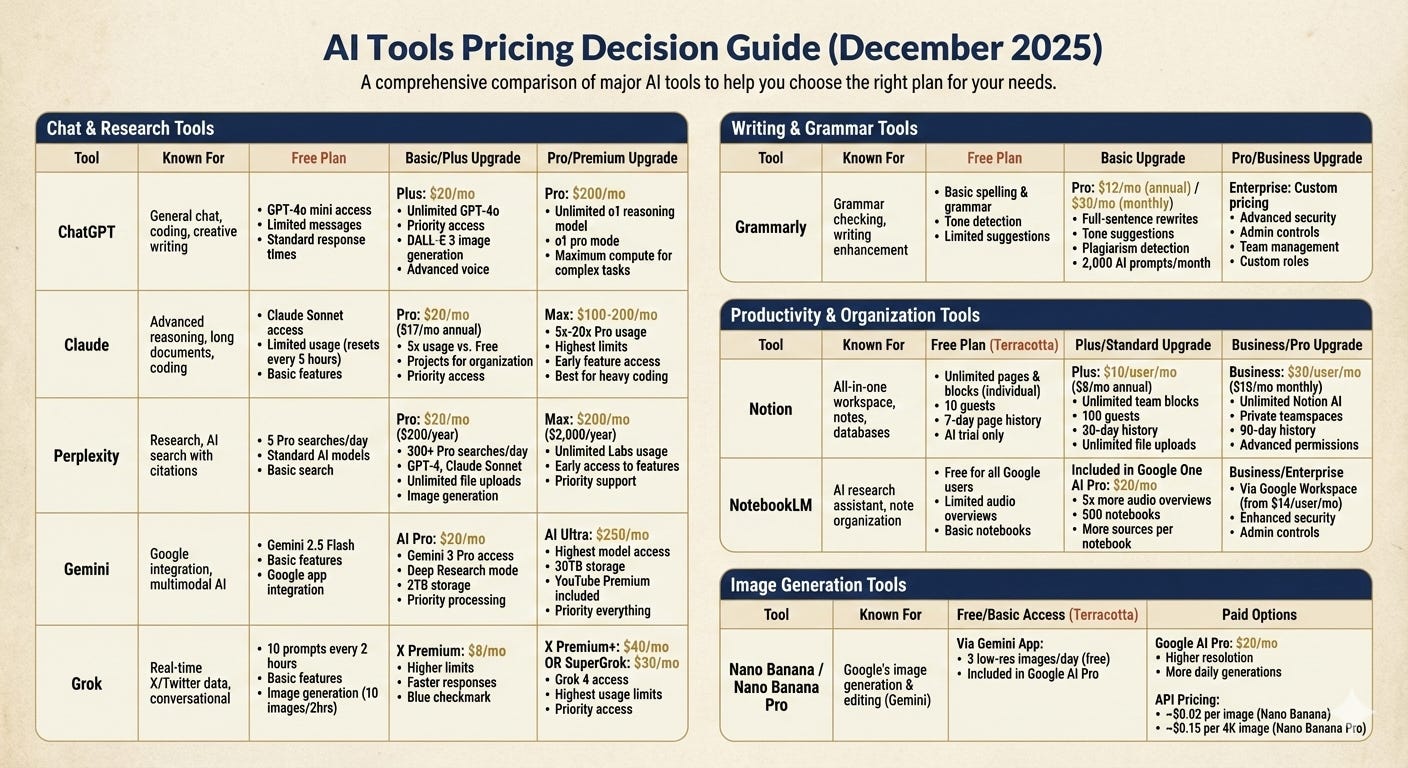
Nano Banana created this chart for me based on research for AI Tools Pricing. I’ll be honest, it’s a nice chart for today, but it will be obsolete in months as new tools come into the market. The key takeaway is that they cost money and ideally you pick one or two to really test out before you commit. I have tried all of the tools below.
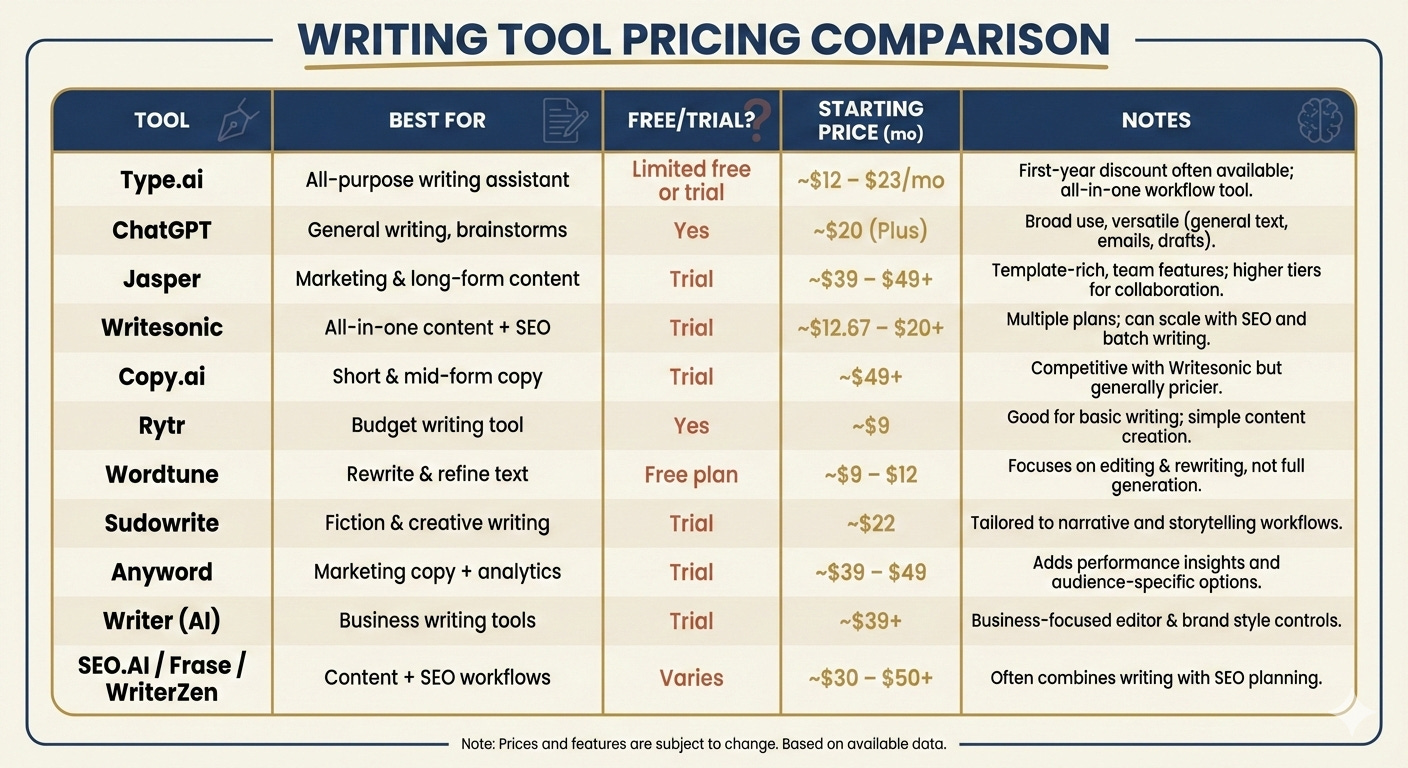
For future books, I’m considering in investing in one of these tools below specifically designed for writing professional papers, books and research documents. I have never tried the tools below, so let me know if you have a favorite here: (generated by Nano Banana)
Lessons Learned in creating the eBook
Cost - AI tools aren’t free and you can quickly spend a ton of cash if you’re not intentional with your requirements.
Growth mindset - All of the AI tools have a learning curve, which takes time. Just something to keep in mind.
Beware - Many of the tool reviews out there were done for advertising, likes or promoting something, but a lot of those reviewers are just recycling AI slop posts where no one has actually used the tool to success.
Style - My writing still has a LinkedIn/Corporate/Quick-post vibe. Which is not my goal. I am going to get back to the art of writing, and for my newsletters, refrain from the breaks in every line or so and disjointed thoughts for scrollers and short attention spans. Writing a newsletter, post, note or a book are not the same thing. Your brain goes to a different place if you have limited space and time. They should each represent a different depth on a topic.
Why - If you are focusing on dopamine hits from “likes” or “subscribers,” then you are writing for attention, not a book. Stay focused. Start with your “why.”
Audience - You can always change it up down the road if it’s not scratching the right itch, but pick an audience and a plan to deviate from. I narrowed in on my audience to write for non-tech leaders, but quickly realized there’s so much needed to share with educators and parents.
Brand - Stick to a brand. If you don’t have one, create one. ChatGPT helped me in the beginning with mine.
Privacy - don’t overshare.
Values - don’t lose sight of what’s important to you.
Human touch - There is simply no tool on the market better than a human for helping humans. If you are a designer, writer, or artist. Your job is SAFE. AI will only help you. But is definitely not replacing you.
Grit - Show up and push through when it gets tough and you run into roadblocks.
What’s Next
I’m continuing to deep dive on AI tool assessment, adoption, governance, privacy, security and ethical best practices, which will be reflected in future posts.
Book 2, coming out in Q1 2026, is focused on expanding AI Adoption to educators and parents with the same foundational concept, “don’t buy a tool until you’ve got a plan.” It will also include “non-negotiables” recommendations to double-down on ethics and safety with AI.
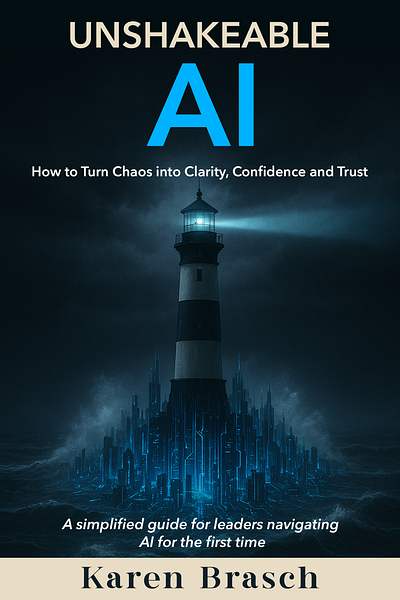
Link to my FREE eBook, “Unshakeable AI: How to Turn Chaos Into Clarity, Confidence and Trust. A Simplified Guide to Leaders Navigating AI for the First Time.”
LOVE this my friend...well done! I have loved following your journey...(since 1997 😊)
Congratulations on your first book and regaining your time and joy of writing! The guide you created here is very helpful but I just loved your story: from a successful career in high-tech to burnout, to recovery, to rediscovering the simple joy of a museum visit in the middle of the day, and to going back to your earlier love of writing. It resonated deeply, as I experienced the same arc, but in wealth management; once the burnout healed, my love for what I did came back in the form of Substack. Funny how things work when it comes to things we feel we were meant to do...
I wish you reach all the new goals you set and keep the love of writing, experimenting, and creating as fresh and happy as it comes out in this post. Visit every posh coffee shop in London and enjoy every moment!